Best Index Funds to Invest in 2024 sets the stage for this enthralling narrative, offering readers a glimpse into a story that is rich in detail with casual formal language style and brimming with originality from the outset.
Investing in index funds is a crucial aspect of financial planning, and selecting the right ones can make a significant difference in one’s portfolio. In this guide, we will delve into the top 5 index funds recommended for 2024 and explore the criteria used to choose them, their performance over recent years, and the unique features that set them apart.
Best Index Funds to Invest in 2024
Investing in index funds can be a great way to diversify your portfolio and minimize risk. Here are the top 5 index funds recommended for investment in 2024 based on their performance and potential for growth.
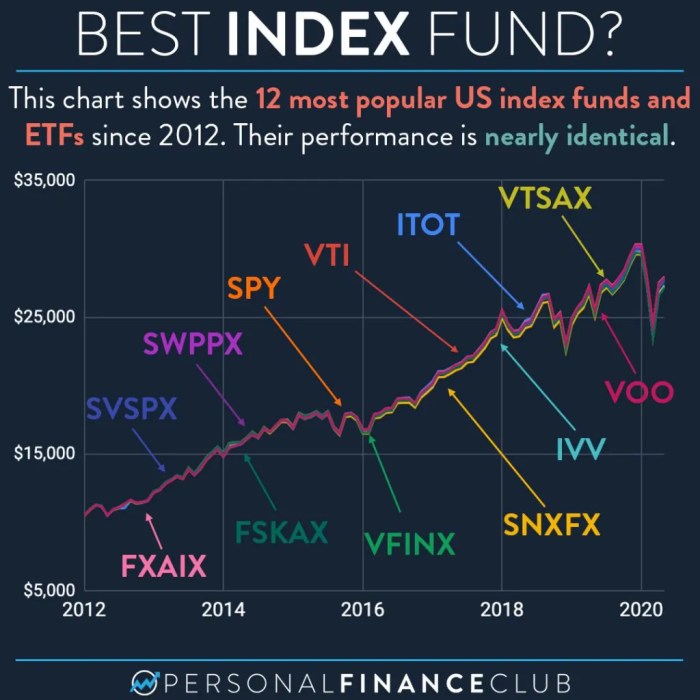
Vanguard Total Stock Market Index Fund (VTSAX)
The Vanguard Total Stock Market Index Fund is a popular choice among investors looking for broad exposure to the U.S. stock market. It includes large, mid, small-cap stocks, providing diversification within a single fund.
Schwab S&P 500 Index Fund (SWPPX)
The Schwab S&P 500 Index Fund tracks the performance of the S&P 500 index, which represents the 500 largest companies in the U.S. This fund offers low expenses and has historically delivered strong returns.
iShares Russell 2000 ETF (IWM)
The iShares Russell 2000 ETF focuses on small-cap stocks, providing exposure to companies with significant growth potential. This fund is ideal for investors seeking higher returns but are willing to accept higher volatility.
Fidelity ZERO International Index Fund (FZILX)
For investors looking to diversify globally, the Fidelity ZERO International Index Fund is a great option. This fund offers exposure to international developed and emerging markets, providing a well-rounded portfolio.
Schwab U.S. Aggregate Bond ETF (SCHZ)
The Schwab U.S. Aggregate Bond ETF is a good choice for investors looking to add fixed-income securities to their portfolio. This fund tracks the Bloomberg Barclays U.S. Aggregate Bond Index, providing exposure to a wide range of U.S. investment-grade bonds.
Income Funds
Income funds are a type of mutual fund or exchange-traded fund (ETF) that primarily focuses on generating regular income for investors through dividends, interest payments, or other fixed-income securities. These funds are suitable for investors seeking a steady stream of income while aiming to preserve their capital.
Comparison between Income Funds and Index Funds
Income funds differ from index funds in terms of their investment objectives. While index funds aim to replicate the performance of a specific market index, income funds prioritize generating income for investors through interest or dividend payments. Additionally, income funds may hold a mix of bonds, dividend-paying stocks, and other fixed-income securities, while index funds typically track the performance of a specific market index.
Top Income Funds in the Market
- Vanguard High Dividend Yield Index Fund
- Fidelity Strategic Income Fund
- PIMCO Income Fund
These income funds have a track record of delivering consistent income to investors through a diversified portfolio of income-generating assets.
Potential Risks Associated with Investing in Income Funds
Income funds are subject to interest rate risk, credit risk, and market risk. Fluctuations in interest rates can impact the value of fixed-income securities held in the fund. Credit risk arises from the possibility of bond issuers defaulting on payments, leading to potential losses for investors. Market risk refers to the general volatility of the financial markets, which can affect the overall performance of income funds.
Inflation Hedge
Inflation can erode the purchasing power of investment returns over time, making it crucial for investors to protect their portfolios against its effects. Index funds can serve as an effective hedge against inflation due to their diversified nature and exposure to a wide range of assets.When inflation rises, the value of traditional investments like cash, bonds, and fixed-income securities tends to decrease in real terms.
This can lead to lower overall returns for investors. However, index funds, which typically include a mix of stocks and bonds, can help offset the impact of inflation by providing exposure to assets that have the potential to outpace inflation over the long term.
Impact of Inflation on Investment Returns
Inflation can reduce the real value of investment returns by decreasing the purchasing power of money. For example, if inflation is running at 3% annually and an investment earns a 4% return, the real return would only be 1% after adjusting for inflation. This highlights the importance of choosing investments that can keep pace with or outpace inflation.
- Index funds with exposure to equities have historically provided returns that outpace inflation over the long term.
- Fixed-income index funds may struggle to keep up with inflation, as bond yields may not increase sufficiently to offset rising prices.
Effectiveness of Index Funds as an Inflation Hedge
Index funds, particularly those focused on equities, have shown the ability to provide returns that outpace inflation over time. By investing in a broad market index, investors gain exposure to a diverse set of companies that have the potential to grow their earnings and dividends, helping to preserve the real value of their investments.
- Compared to actively managed funds, index funds typically have lower fees, which can help enhance overall returns and reduce the impact of inflation.
- Index funds offer broad diversification, reducing the risk of individual stock or sector underperformance impacting the overall portfolio.
Strategies for Protecting Portfolios Against Inflation
Investors can employ several strategies to protect their portfolios against inflation using index funds. One common approach is to allocate a portion of the portfolio to equity index funds, which have historically provided returns that outpace inflation over the long term. Additionally, investors may consider diversifying into real assets like commodities or real estate through index funds to further hedge against inflationary pressures.
By incorporating a mix of equity and real asset index funds in their portfolios, investors can help mitigate the impact of inflation and preserve the real value of their investments over time.
Insurance Premiums
Investing in index funds can have an impact on insurance premiums, as the performance of these funds can affect the overall financial health of insurance companies. Let’s explore the relationship between index funds and insurance premiums in more detail.
Role of Index Funds in Determining Insurance Premiums
Index funds play a significant role in determining insurance premiums, especially in products like variable universal life insurance and indexed universal life insurance. These types of insurance policies allow policyholders to allocate a portion of their premiums into investment accounts that are often tied to index funds.
- Index funds can influence the cash value accumulation in these policies, which in turn affects the premiums paid by the policyholders.
- The performance of the index fund chosen can impact the growth potential of the investment portion of the policy, ultimately affecting the cost of insurance.
Pros and Cons of Using Index Funds to Manage Insurance Costs
Using index funds to manage insurance costs comes with its own set of advantages and disadvantages.
- Pros:
- Index funds offer diversification and potentially higher returns compared to traditional fixed-interest investments, which can help policyholders accumulate more cash value.
- Policyholders have the opportunity to benefit from the growth of the stock market through their index fund investments.
- Cons:
- Market volatility can lead to fluctuations in the cash value of the policy, impacting the premiums that need to be paid.
- If the chosen index fund underperforms, it can negatively affect the cash value accumulation and potentially increase the cost of insurance.
In conclusion, Best Index Funds to Invest in 2024 provides a comprehensive overview of the top index funds to consider for the upcoming year. Armed with this knowledge, investors can make informed decisions to optimize their investment strategies and potentially enhance their returns.
FAQ Resource
What criteria were considered when selecting the top 5 index funds for 2024?
The criteria included factors such as historical performance, expense ratios, diversification, and the fund’s ability to track the underlying index effectively.
How do index funds serve as a hedge against inflation?
Index funds typically hold a diversified portfolio of assets that can adjust to inflationary pressures, providing a reliable way to preserve purchasing power over time.
Can investing in index funds impact insurance premiums?
Yes, investing in index funds can affect insurance premiums, as insurers may consider the performance of these funds when determining policy costs.