Embark on a journey to discover the intricacies of selecting the perfect index fund with our detailed guide on How to Choose the Right Index Fund. Exploring the nuances of investment choices and financial goals, this article offers valuable insights for both novice and seasoned investors.
Introduction to Index Funds
Index funds are a type of investment fund that aims to replicate the performance of a specific market index, such as the S&P 500. Unlike actively managed funds, which involve a fund manager making decisions to buy and sell securities, index funds passively track the index they are based on.
Investing in index funds offers several benefits for individuals with long-term financial goals. These funds typically have lower fees compared to actively managed funds, as they require less management. Additionally, index funds provide diversification by holding a large number of securities within the index, reducing individual stock risk.
Comparing Index Funds with Actively Managed Funds
- Performance: Over the long term, index funds have been known to outperform actively managed funds due to their lower fees and ability to match the market’s performance.
- Costs: Index funds generally have lower expense ratios compared to actively managed funds, making them a cost-effective investment option.
- Transparency: Index funds are transparent in their investment strategy since they aim to replicate the index, whereas actively managed funds may have less visibility in their decision-making process.
Factors to Consider When Choosing an Index Fund
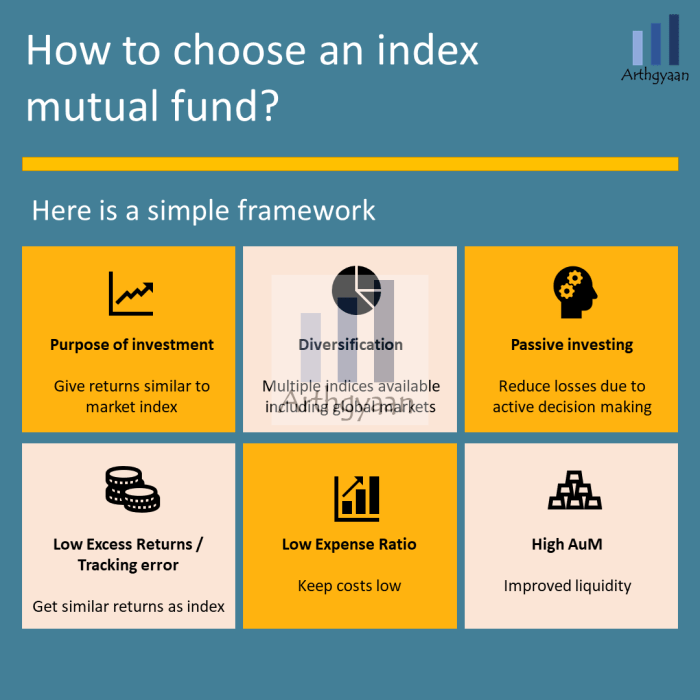
When selecting an index fund, there are several key factors that investors should carefully consider to make an informed decision.
Importance of Expense Ratios and Management Fees
Expense ratios and management fees play a crucial role in determining the overall cost of investing in an index fund. These fees are deducted from the fund’s assets to cover operating expenses and management costs. It is essential to choose an index fund with low expense ratios and fees to maximize your returns over time. High fees can significantly eat into your investment gains and erode your overall portfolio value.
- Look for index funds with competitive expense ratios compared to similar funds in the market.
- Consider the impact of management fees on your investment returns over the long term.
- Choose index funds with transparent fee structures to avoid any hidden costs.
Significance of Tracking Error and Index Replication Methods
Tracking error measures how closely an index fund follows its benchmark index. A low tracking error indicates that the fund closely mirrors the performance of the index. Investors should consider the tracking error of an index fund to ensure that it accurately replicates the intended market exposure.
Tracking error is a key metric to assess the effectiveness of an index fund in tracking its benchmark index.
- Understand the index replication method used by the fund, such as full replication, stratified sampling, or optimization.
- Compare the tracking error of different index funds tracking the same index to identify the most efficient option.
- Aim for index funds with low tracking error to minimize deviations from the benchmark performance.
Types of Index Funds
Index funds come in various types, each designed to meet different investment objectives and risk tolerance levels. Let’s explore some of the common types of index funds available in the market.
Income Funds vs. Index Funds
Income funds focus on generating regular income through dividends and interest payments, making them suitable for investors seeking steady cash flow. However, they tend to carry higher risk due to the nature of the underlying securities. On the other hand, index funds aim to replicate the performance of a specific market index, providing diversification and potentially lower fees. While income funds offer higher potential returns, index funds are often preferred for long-term growth and stability.
Index Funds as Inflation Hedge
Index funds can serve as an inflation hedge in a diversified portfolio by providing exposure to a wide range of assets that have historically outpaced inflation. By investing in index funds that include inflation-sensitive assets like commodities, real estate, and TIPS (Treasury Inflation-Protected Securities), investors can protect the purchasing power of their investments against inflationary pressures. This can help maintain the value of the portfolio over time and potentially generate positive real returns even in inflationary environments.
Strategies for Selecting the Right Index Fund
When it comes to choosing the right index fund, there are several key strategies that can help investors make informed decisions based on their financial goals and risk tolerance.
Research and Evaluation
- Start by clearly defining your investment goals and risk tolerance to determine the most suitable index fund for your portfolio.
- Research different index funds to understand their historical performance, expense ratios, and tracking error compared to the benchmark.
- Consider factors such as fund size, liquidity, and management team reputation when evaluating index funds.
- Look for consistency in performance and a track record of closely tracking the index over time.
Diversification and Asset Allocation
- Diversification is key to reducing risk in your investment portfolio. Choose index funds that provide exposure to a wide range of asset classes and sectors.
- Consider your overall asset allocation strategy and how different index funds can help you achieve a well-balanced and diversified portfolio.
- Avoid overlapping investments by ensuring that each index fund in your portfolio offers exposure to different market segments.
- Regularly review and rebalance your portfolio to maintain the desired asset allocation and risk level.
Impact on Insurance Premiums
- Investing in certain index funds that are highly volatile or high-risk can impact the insurance premiums you pay.
- Insurance companies may adjust premiums based on the risk profile of your investment portfolio, including holdings in index funds.
- Consider the impact of your index fund choices on your overall financial plan, including insurance coverage and risk management strategies.
- Consult with a financial advisor to understand how investing in specific index funds may affect your insurance premiums and overall financial goals.
In conclusion, understanding the key factors and strategies in choosing the right index fund is crucial for long-term financial success. With the knowledge gained from this guide, investors can make informed decisions to enhance their investment portfolios and achieve their financial objectives.
Expert Answers
What are index funds?
Index funds are investment funds that aim to track the performance of a specific market index.
How do expense ratios affect index fund selection?
Low expense ratios are preferred as they reduce the overall cost and increase returns for investors.
Can index funds serve as an inflation hedge?
Yes, index funds can act as an inflation hedge by providing exposure to a diversified portfolio.